
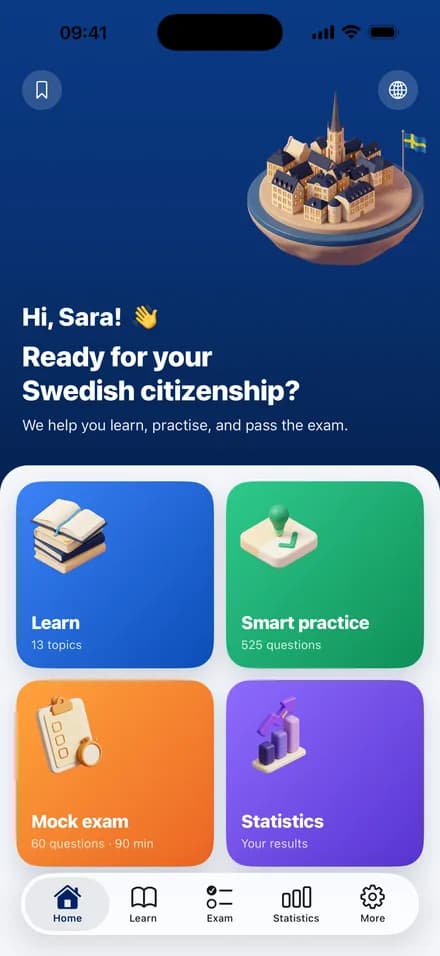


What the citizenship test is
The citizenship test is a civics test. It measures basic knowledge of how Sweden works — democracy, the law, the labour market, welfare and public life generally. It became a requirement through the citizenship law that took effect on 6 June 2026.
The test is administered by the Swedish Council for Higher Education (UHR). It is based on a single fixed study guide, Sverige i fokus, published free of charge. That the material is fixed works in your favour: there is no hidden syllabus and nothing to guess at.
- The test is in Swedish
- Content comes solely from the 13 chapters of Sverige i fokus
- It is a multiple-choice test — you choose from given options
- It can be retaken at a later sitting
Who needs to take the test
The requirement applies to applicants of working age. The law sets age limits at both ends — anyone younger or older than those limits is not covered by the knowledge requirement.
Exemptions also exist for people who cannot sit a test because of illness, injury or disability. These are assessed individually and you need documentation to support the grounds. The assessment is made by the Migration Agency as part of your application — not by us, and not by the body that administers the test.
Always check your own situation with the Migration Agency. No summary can replace a decision in your own case.
We cover the other citizenship requirements — identity, residence time and good conduct — on the Laws & rules page.
What the test covers
All 13 chapters of Sverige i fokus may appear. They range from the country's geography and democratic system to law and justice, the role of the media, human rights, the labour market, welfare, modern history, Sweden's place in the world, freedom of religion and traditions.
The emphasis is on understanding rather than recall. Questions more often concern how something works — who decides what, which body to turn to — than individual dates or figures.
Format and how it is run
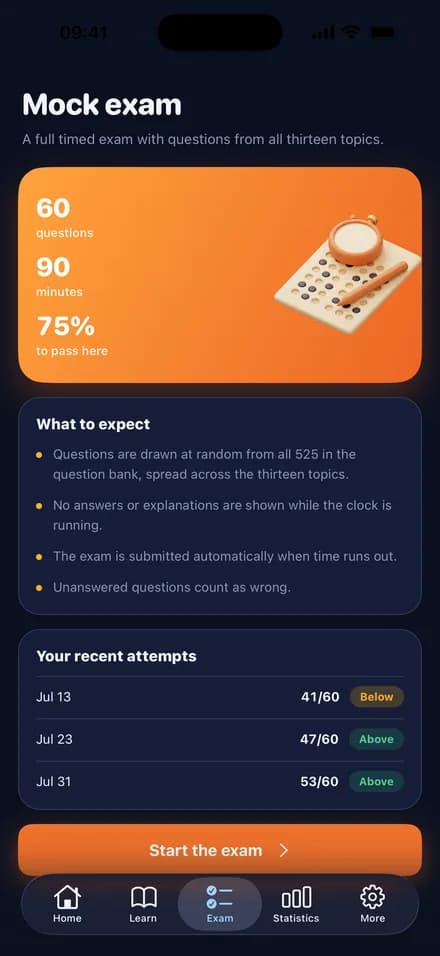
UHR describes the test as roughly 60 multiple-choice questions with four options, one of which is right. The actual test time is 90 minutes. UHR has not published a pass mark. Claims about the format have circulated in the media and in discussion groups since the law was passed, but it is UHR's published format description that counts. Never plan around second-hand figures.
What you can prepare regardless of format is stamina: staying focused through a full sitting, and answering in Swedish without getting stuck on the phrasing. Practise at least once against the clock before test day.
We summarise the 13 topic areas under Study areas, and cover how to structure your preparation under Tests & practice.
How to prepare
- Download Sverige i fokus and read all 13 chapters once, at a calm pace
- Drill multiple-choice questions chapter by chapter, right after reading each one
- Revisit what you got wrong — not the material from the start again
- Use the audio files to revise while commuting or walking
- Sit at least one full timed mock exam before test day
Read explanations in your strongest language when a concept is hard — but always return to the Swedish wording afterwards. That is what you meet on the test.
Sources
- UHR — the Swedish Council for Higher Education
- Migrationsverket — becoming a Swedish citizen
- Riksdagen — the Swedish Citizenship Act
Official details can change. Always confirm what applies to your own case directly with the responsible authority.